

Summary: Constructed wetlands can help to capture nutrients from agriculture run-off before they enter water bodies. The efficiency of a wetland for nutrient retention (sedimentation, uptake by plants and denitrification) is mainly affected by the nutrient load and the residence time for the water entering the wetland.
Operation and Applicability: Annual management may include removal of sediment, dam maintenance or removal of vegetation either by cutting or grazing.
Efficiency: Up to 40 % P and 20 % N during growing season. Nutrients may be released back to the environment during autumn and winter (September to May).
 Efficiency and functionality Costs of the Practice Ease of Operation
Potential for nutrient recovery
Basics of the good practice:
Suitable locations for a wetland include for example natural hollows and depressions, water meadows susceptible to flooding, and terraced drainage areas. Old drained wetlands can also be restored.
Larger wetlands operating at long hydraulic retention times capture nutrients efficiently. In Sweden, it is recommended that the catchment area of the wetland (with the focus on nitrogen retention) be large (>100 ha) and comprised of mostly field area (~70%).
If the wetland is meant to create wildlife and attract birds, a good rule of thumb is that 50% of its surface should be open water area and 50% should be covered with vegetation.
In Finland, it is recommended that the area of the wetland should be at least 1-2% of the size of its catchment area. The wetland should also be situated near the nutrient loading source.
Small wetlands can improve biodiversity but their efficiency in reducing nutrient loads is questionable. Relatively shallow wetlands are best for both nutrient retention and improving biodiversity.
Costs of the Practice: The costs of wetland construction depend on the size, location and structure of the wetland. Most costs come from digging, planting and wetlands management and maintenance. Because of many variables, the costs vary widely from place to place and they can be from less than one to tens of thousands of EUR/ha.
Ability for climate chance mitigation: The greatest benefits of constructed wetlands in climate change mitigation is in minimizing and reducing stormwater flows. They can also aid with reducing CO2 emissions, however they can contribute to methane (CH4) emissions.
Potential for nutrient recovery: There may be some potential to re-use sediments as a P rich fertilizer however this needs to be investigated in particular cost-benefit analysis need to be carries out.
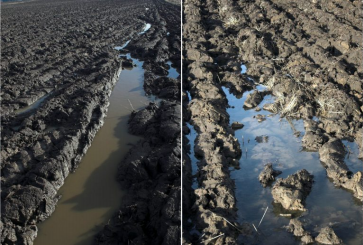
Evidence of Success: Practical example of conctructed wetlands
Proven effect of conctructed wetlands
In a Swedish study (Jordbruksverket, 2010), the capacity of wetlands to retain nutrients was estimated based on water samples and modelling. The 50 wetlands in the study retained on average 59-105 kg of N and 1.7-5.3 kg of P per hectare of wetland surface per year.
In a Finnish study (Koskiaho, 2003), the nutrient retention capacity of three wetlands (one natural and two constructed wetlands) was compared based on moni-toring and modelling. The nutrient load reduction for total nitrogen was 8-38% and for total phosphorus 6-67%.
The constructed wetland with the longest water residence time showed the best performance, retaining annually about 25 kg of total P and 300 kg of total N per hectare. The results of the study indicate the great importance of wetland size for load reductions.
The larger the wetland in relation to its catchment, the longer the residence time of water for the efficient functioning of purifying processes. Input water quality also has an effect on the results. Load reductions remain small if field percentage of the catchment, and thus input concentrations, are low.
Using the SWAT model, Koskiaho et al. (2013) found that establishing several constructed wetlands on the upper reach of a catchment was much more effective than constructing one large wetland at the outlet of the same catchment.
The total area was equal. They also found that with diluted waters, P precipitation is substantially lower than with waters rich in phosphorus. Thus locating constructed wetlands near the sources of loading is highly recommended.
Evidence of success:
- PP in the river has decreased 26% compared to reference area by first spring
- Salts increase ionic strenght of the soil and improve granular structure and diminish erosion
- From the gypsum treated fields PP runoff has decreased 60 %
- Gypsum affects immediately after dissolving into the ground and impact lasts for several years.
AAbout the sulfate:
- EC increased in the water due to Ca-ions and sulfates
- Before gypsum: 13 mg SO4/l
- After gypsum: 32 mg SO4/l
- Could be used in the fields where receiving water system is NOT a lake because sulfates disturb Psedimentation process.
Table:
The cost per kg reduced N and P based on payments for installation and maintenance. Swedish EPA (2009)