

Summary: Gypsum application on the clay fields decrease soil erosion and both particle phosphorus (PP) and dissolved phosphorus (DP) runoff into the waters. P stays available for the plants. Gypsum is a good practice for the water conservation but it can only be used on the fields where receiving water system is not a lake.
Operation and Applicability: The gypsum is applied on the field surface before soil tilling. The moist weather may impede handling and spreading of the gypsum.
Efficiency: 4 tons/ha application of the gypsum may decrease PP runoff 60 %. Gypsum also improves ionic strength and granular structure of the soil.
 Efficiency and functionality Costs of the Practice Ease of Operation and maintenance
Potential for nutrient recovery
- CaSO4 * 2 H2O
- Application 4 tons/ha and tilling into the soil
- Absorbs both particle and dissolved phosphorus
- Forms insoluble Ca-phosphate complexes but phosphate is still available for the crop plants
- Improves granular structure of the soil and prevents soil erosion from the clay fields
- Has no the soil neutralization effect
- Sulfate runoff disturbs P-sedimentation process in the lakes -> limits usage
- Can be used on the fields where brackish water or sea receives runoff waters
Costs of the Practice: Gypsum transport, spreading and application equipment (same as for liming), cost of labour and gypsum costs ≈ 70 €/ha
Ability for climate chance mitigation: When the soil structure and nutrient utilization in the field is improved it decreases the risk for the changes due to climate change e.g. less soil erosion during torrential rains.
Potential for nutrient recovery: Nutrients are available for the plants after treatment even tough the phosphorus runoff is reduced. Improves the nutrient utilization in the farm and P-loss is prevented.
Evidence of Success: Savijoki river & SAVE project
Savijoki river (28 km long) in the South-East of Finland runs to Aurojoki-river which leads to Baltic Sea.
The catchment area is 130,50 km2 and there is no lakes. The river water used to turn into muddy after rainy
seasons and snowmelting in the springs by reason of the soil erosion from clay fields.
The aim of the project is to clarify waters and improve water quality with soil amended gypsum and decrease Pload and land erosion from agricultural lands to decrease algae blooms in the coastal waters.
Gypsum treatment:
- Clarifies water
- Salts increase ionic strenght of the soil and improve granular structure and diminish erosion
- Possibly improves crop yields and quality
- Decreased both dissolved and particulate phosphorus runoffs
Evidence of success:
- PP in the river has decreased 26% compared to reference area by first spring
- Salts increase ionic strenght of the soil and improve granular structure and diminish erosion
- From the gypsum treated fields PP runoff has decreased 60 %
- Gypsum affects immediately after dissolving into the ground and impact lasts for several years.
AAbout the sulfate:
- EC increased in the water due to Ca-ions and sulfates
- Before gypsum: 13 mg SO4/l
- After gypsum: 32 mg SO4/l
- Could be used in the fields where receiving water system is NOT a lake because sulfates disturb Psedimentation process.
1550 ha
6200 tons gypsum
55 farmers
4 tons gypsum/ha
Decreased erosion from clay soils and
phosphorus runoff!
Phosphorus is still available for the plants!
No negative feedback from the farmers!
Gypsum is a good practice for water conservation!
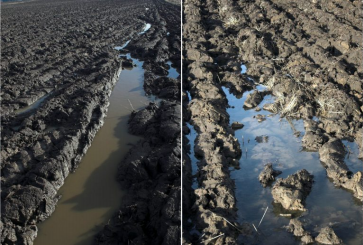
Before and after gypsum treatment
Pictures: Pasi Valkama (SAVE project)